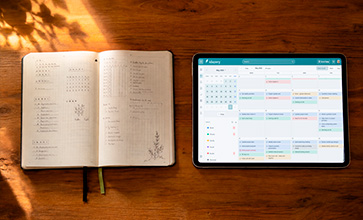


There’s a useful distinction that often gets lost in how people talk about journaling for ideas. An idea journal is where thoughts go when they show up on their own — an observation, a half-formed plan, something you don’t want to lose. A brainstorming journal works the other way around: you start with a problem, and you sit down specifically to generate options for it.
The difference isn’t just where the ideas come from — it’s the shape of the whole session. An idea journal entry can be a single sentence, written at any time, with no expectation that anything follows from it. A brainstorming session has a starting question, a rule about generating before judging, and a goal: arrive at a next step you didn’t have when you sat down.
This article is about that second kind of session — what makes it different from an idea journal and from free writing, how to run one, and what to do with what comes out of it.
Why thinking on paper is different from thinking in your head
When you think through a problem in your head, the options you’re considering aren’t visible at the same time. They arrive one after another, compete briefly for attention, and the most familiar one — the one closest to what you did last time, or the one you’d already half-decided on — tends to win by default, often before the others have been properly considered.
Writing changes this by making the options simultaneous. Once an option is on the page, it stays there while you write the next one. You can look at three or four options at once, compare them directly, combine parts of two into a third, or set one aside without losing it — something that’s much harder to do when everything has to be held in working memory at the same time.
That simultaneous view changes how the options get evaluated. An option that felt like the obvious answer when it was the only thing in your head often looks different once it’s sitting on the page next to three others — not necessarily worse, just no longer the only thing you were comparing it to. Writing things down changes how you think in general, and this is one of the more concrete ways that shows up: it’s not that writing makes you smarter, it’s that it makes more than one option visible at once.
What makes a brainstorming session in a journal different from free writing
Free writing — writing without direction, whatever comes to mind — is useful for processing emotions or for getting unstuck when your thinking feels blocked. It works because it has no agenda: you write, and whatever surfaces, surfaces.
A brainstorming session in a journal works differently. It starts with a question, it has an explicit intention to generate options, and it has a way of telling whether the session produced something useful. The difference shows up in how each one starts:
- Free writing: “I’m going to write about what I think of this situation.”
- Brainstorming session: “I’m going to write down at least five different ways I could approach this problem, before deciding which one to pursue.”
The second produces something the first doesn’t — not because it’s more disciplined for its own sake, but because the intention to generate a specific number of options activates a different kind of thinking than the intention to describe how you feel. Free writing tends to follow your existing thoughts. A brainstorming session asks for thoughts you don’t have yet, and gives you a reason to keep going until you do.
How to run a brainstorming session in your journal
The process below isn’t complicated, but each step does something specific — skipping one tends to produce a session that reads like free writing with extra steps, rather than one that ends with options you can actually act on.
Define the question precisely
A brainstorming session is only as good as the question that starts it. “How can I improve my situation?” is too broad to generate anything concrete — there’s nowhere for the writing to go. “What could I do this week to make progress on X?” or “What are three different ways I could approach this with the resources I have right now?” gives the session something to push against.
Write the question at the top of the page, on its own line, before writing anything else. It sounds like a small step, but it changes what you write next — you’re answering a specific question instead of writing in general.
Generate without filtering
This is the most important rule in any brainstorming process, on paper or otherwise: separate generating from evaluating. While you’re generating, write down options without judging them — including the ones that seem bad, impractical, or slightly absurd.
Options dismissed too early often contain the seed of something that does work — but only if they get written down before being dismissed. A concrete target helps: “I’ll write at least eight options before I evaluate any of them.”
Evaluate with explicit criteria
Once you have options on the page, switch modes — from generating to evaluating. Write down, explicitly, what actually matters for this decision. Not criteria in general, but the ones that apply to this specific situation.
Then evaluate each option against those criteria, also in writing. Doing this in your head lets the criteria shift without your noticing — an option can start to look better simply because the standard quietly moved to fit it.
Identify the next step
The goal of a brainstorming session isn’t to land on the perfect option — it’s to reduce uncertainty enough to take a concrete next step. End every session with a sentence that starts: “The next thing I’m going to do is…”
Without that sentence, the session produces clarity but not movement. With it, the session has a result — even if the result is just “find out X before deciding.”
When a brainstorming journal is most useful
This isn’t a tool for everyday thinking — it’s for specific situations where circular thinking isn’t getting you anywhere:
- A decision you’ve been turning over for days without making progress.
- A problem that seems to have only one obvious solution, and you want to check whether that’s actually true.
- A project that’s stalled, where you’re not sure how to continue.
- A difficult conversation you need to prepare for carefully.
- A goal you want to reach but don’t know how to start working toward.
In each of these cases, a brainstorming session produces something thinking alone doesn’t: options that are visible and can be compared, instead of options circulating in your head, competing for attention without ever getting resolved. The session doesn’t have to solve the whole problem — it just has to get you from “I don’t know where to start” to “here’s what I’m going to try first.”
The difference between a brainstorming journal and an idea journal
An idea journal captures what shows up — observations, half-formed thoughts, connections you notice without looking for them. Writing down your thoughts as they occur is what makes that kind of journal useful: nothing gets lost just because you didn’t have time to think it through properly in the moment.
A brainstorming journal generates what you need — options for a specific question, produced in a deliberate session. These aren’t competing tools; many people keep both in the same journal, and what separates them is the intention behind opening the page. If you open it without knowing what you’ll write, that’s an idea journal entry. If you open it with a question already in mind, that’s a brainstorming session.
If you want a wider view of how journaling styles like these fit together, our overview of the most popular types of journals covers both, along with several others.
What to do with the output
A brainstorming session leaves you with raw material: a set of options generated without filtering, evaluated against criteria you wrote down explicitly, and a next step identified at the end.
That material is useful on two different timelines. The next step is immediate — something you can act on directly, often the same day. The options you generated but didn’t choose are useful later, on a different timeline: a constraint that rules something out today might not apply in three months, and an option that looked wrong for this decision might be exactly right for a different one.
This is part of why it’s worth keeping the session itself, not just its conclusion. In idazery, each brainstorming session lives on the same dated timeline as the rest of your entries — searchable later, for whenever an option you set aside becomes relevant again.
A brainstorming journal doesn’t need an elaborate setup. It needs a specific question, the discipline to generate options before judging them, and explicit criteria for deciding between them.
What it produces isn’t inspiration — it’s visibility. The options were often available all along; circular thinking just didn’t let you see them at the same time. Writing them down does.
idazery’s timeline gives you a private place to run a session like this whenever you need one — a daily journal ready to write in the moment a question comes up, with nothing to set up first.
If you're a creative professional looking for a private space where ideas, blocks and your creative process all have a place, here's how idazery works as a journal for creatives.
Ready to think through a problem on paper?
idazery gives you a private space to run a brainstorming session whenever you need one — no setup, no blank templates to configure first. Use it for 30 days. If it’s not for you, I’ll give you your money back.
See idazery’s Plans →