

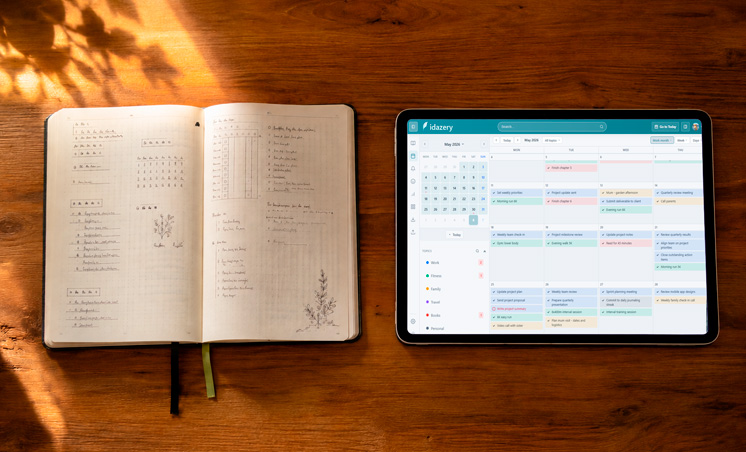
Ryder Carroll designed the Bullet Journal® method for a paper notebook. He is explicit about this — the tactile act of writing by hand, he argues, slows you down enough to think clearly. And he is right. But for most people, the notebook becomes the obstacle. It stays at home when you need it at work. It fills up and gets replaced, breaking continuity. You can't search it. You can't back it up.
The good news is that the core of the Bullet Journal method has nothing to do with paper. It is a system of habits and structures that translates naturally to digital tools — if you choose the right one.
What the Bullet Journal method actually is
Before going digital, it helps to understand what makes the method work. At its core, the Bullet Journal is built around four ideas:
- Rapid logging captures thoughts, tasks and events quickly using a simple notation system. A dot for a task. A dash for a note. A circle for an event. Speed and simplicity are the point — you write things down before you lose them.
- Collections group related entries together. Your daily log captures what happens each day. Your monthly log gives you an overview of the month. Topic-based collections — a reading list, a project, a recurring theme — let you track anything over time.
- Migration is the most powerful habit in the system. At the end of each day or week, you review unfinished tasks and decide consciously: do them, schedule them, or drop them. Nothing carries forward automatically. Every task is a deliberate choice.
- Reflection connects everything. Regular reviews — daily, weekly, monthly — turn the system from a simple task list into a tool for understanding your patterns, your priorities and your progress.
These four ideas work on paper. They work even better digitally — for reasons Carroll himself acknowledges: search, sync, backup, and the ability to reorganise without rewriting everything by hand.
The limitations of paper that digital solves
A paper Bullet Journal has real strengths. The friction of writing by hand is not a bug — it is a feature. Slowing down to write forces a kind of attention that typing rarely achieves.
But paper has hard limits that most people eventually hit:
- You can't migrate automatically. In a paper journal, migration means rewriting tasks by hand into the next day or week. This is intentional — Carroll wants you to feel the weight of each task you carry forward. But in practice, most people stop doing it after a few weeks because it takes too long.
- You can't search your past entries. A paper journal from six months ago is effectively invisible. You know something is in there but finding it means flipping through pages. Over time, the historical value of your journal degrades simply because access is too slow.
- You can't see patterns. One of the most valuable things a journal can do is reveal trends you wouldn't notice day to day — how your mood correlates with certain types of work, which topics keep recurring, how your task completion rate changes over weeks. Paper can't show you this. The data is there but it is invisible.
- Continuity breaks when notebooks end. Moving from one notebook to the next is a genuine disruption. Collections get abandoned. Context is lost. The system resets in a way that digital never does.
How to do Bullet Journal digitally — the core mapping
Moving the method to a digital tool is straightforward once you understand what each paper element maps to:
- Daily log becomes your daily journal entry. Write your notes, reflections and rapid log items exactly as you would on paper. The date is automatic. The entry is searchable.
- Monthly and weekly logs become your planner views. A good digital tool gives you a monthly overview of your tasks and events, and a weekly view for planning the days ahead. These replace the spreads you would draw by hand at the start of each month.
- Collections become topics or tags. Group entries and tasks by theme — a project, a habit, a recurring area of your life. Over time, these topic-based collections become the most valuable part of your journal: a searchable, filterable record of everything related to a specific area.
- Migration becomes the daily review. At the end of each day, unfinished tasks can be moved forward to tomorrow with a single action. The deliberateness Carroll values is preserved — you still choose consciously — but the friction of rewriting is eliminated.
- Reflection becomes statistics and trends. A digital system that tracks mood, task completion and entry frequency over time gives you something paper never can: objective data about your own patterns. Not just the feeling that things are going well or badly, but evidence.
How to start a digital Bullet Journal in 5 steps
- Choose a tool with a timeline and topics. It needs a chronological view for your daily log and a way to group entries into collections.
- Keep your daily log. One entry per day, with your rapid logging inside it: tasks, events and notes in short lines.
- Create collections. One topic per project, list or area of your life, so related entries stay together.
- Plan the week and the month. Use planner views as your weekly and monthly logs, and put future items on their dates.
- Migrate and reflect once a week. Move what is still open to a new day, drop what no longer matters and reread what you wrote.
Why digital works better for most people
The Bullet Journal method was designed to be analog because Carroll was working with what existed in 2013. Digital tools at the time were either too complex, too distraction-prone, or unable to replicate the simplicity of the notebook. That has changed. The right digital tool now offers everything the paper journal offers — speed, simplicity, a space for honest reflection — plus everything it cannot: search, sync across devices, automatic backup, pattern recognition, and migration without rewriting.
The one thing digital cannot replicate is the physical sensation of writing by hand. If that sensation is essential to your practice, keep the paper. But if what you value is the method — the daily logging, the collections, the migration, the reflection — digital is not a compromise. It is an upgrade.
What to look for in a digital Bullet Journal tool
Not every digital tool supports the Bullet Journal method equally well. The key requirements are:
- A timeline or chronological view that mirrors the daily log structure of the paper journal. Entries should flow naturally from one day to the next, the way pages do in a notebook.
- Topic or collection organisation that lets you group entries and tasks by theme, not just by date.
- Task migration — the ability to move unfinished tasks forward deliberately, day by day.
- Weekly and monthly planner views that replace the hand-drawn spreads at the start of each period.
- Privacy — your journal contains your most honest thinking. It should be encrypted and never shared, sold or used by anyone but you.
A tool that combines all of these with a clean, distraction-free interface is genuinely rare. Most journal apps have no planning features. Most planners have no journaling. The Bullet Journal method requires both — which is precisely what makes finding the right digital home for it more difficult than it should be.
Not sure which kind of journal fits you? See the 10 most popular types of journals and how to choose.
Ready to put this into practice?
idazery already maps onto this method: your Daily Log is a searchable timeline, your Collections are topics, Rapid Logging happens inside each entry, and Migration is one click. Monthly and Future Logs become planner views, and Reflection is built in as statistics and a mood heatmap.
Explore idazery's Digital Journal →Bullet Journal® and BuJo® are registered trademarks of Bullet Journal LLC. idazery is an independent product and is not affiliated with, sponsored by, or endorsed by Bullet Journal LLC or Ryder Carroll.